Backrooms
The past haunts us, but always misremembered. This is the premise of Backrooms, a new film set in the early 1990s and based on a fictional location popularised by 16-yr old Kane Parsons in 2012 on the image board website 4chan (Parsons, now 20, also directed the film). But the idea goes further back than this, beginning in 2012 with an anonymous web user’s interpretation of a photograph of an empty yellow room taken in a former furniture store in the town of Oshkosh, Wisconsin.

In 2019, a user on /x/, a paranormal-themed board on 4chan, first gave the room its name ‘The Backrooms’ with the following description:
‘If you’re not careful and you noclip out of reality in the wrong areas, you’ll end up in the Backrooms, where it’s nothing but the stink of old moist carpet, the madness of mono-yellow, the endless background of fluorescent lights at maximum hum-buzz, and approximately six hundred million square miles of randomly segmented empty rooms to be trapped in’
When Kane Parsons began to post his short films in 2022, the Backrooms vent viral. The 25 episodes that Parsons created were the basis for the film that was released in May 2026. One room became many, a labyrinthine world of many levels that held much in common with video games (unsurprisingly the Backrooms are indeed the subject of several indie games). Amongst internet fans these are what’s known as ‘liminal’ spaces, the classic example being the hotel corridor. They’re spaces that are not inhabited but rather moved through - places of transition. To get stuck in the Backrooms is akin to becoming a ghost - caught between one place and another in a liminal zone.

Watching the film is curiously exhilarating. It’s rare that a cinematic event, especially one experienced in a multiplex, can generate such a strong effect (the five or six trailers I saw before the film all advertised the usual generic horror fare - the latest instalment of the Insidious franchise, for example). These endless yellow rooms were genuinely disconcerting and visceral. To make the film, a labyrinthine set was built, with production designer Danny Vermette adapting his digital designs for physical construction. More than 30,000 square feet of Backrooms was built, requiring 37,000 square feet of yellow wallpaper and 29,000 square feet of mouldering carpet. Mirroring the plot of the film, some of those working on the set apparently got lost.

All of this should have made the film feel nostalgic. After all, it’s set in the early 1990s, shaky hand-held video the predominant media used to record the Backrooms themselves. Yet, the retro-look feels curiously fresh because it reminds us that the largely virtual lives most of us now largely lead are nevertheless predicated on exactly the kind of spaces depicted in this film, but which, like the Backrooms, are almost always carefully hidden from us. AI data centres, ‘dark’ warehouses, subterranean vaults for servers - these are all backrooms to internet users. They are literally ‘occult’ spaces - secret and concealed places where the real internet is kept out of sight and beyond common understanding. To enter the Backrooms is tantamount to transgressing this carefully maintained division between the virtual and the real.

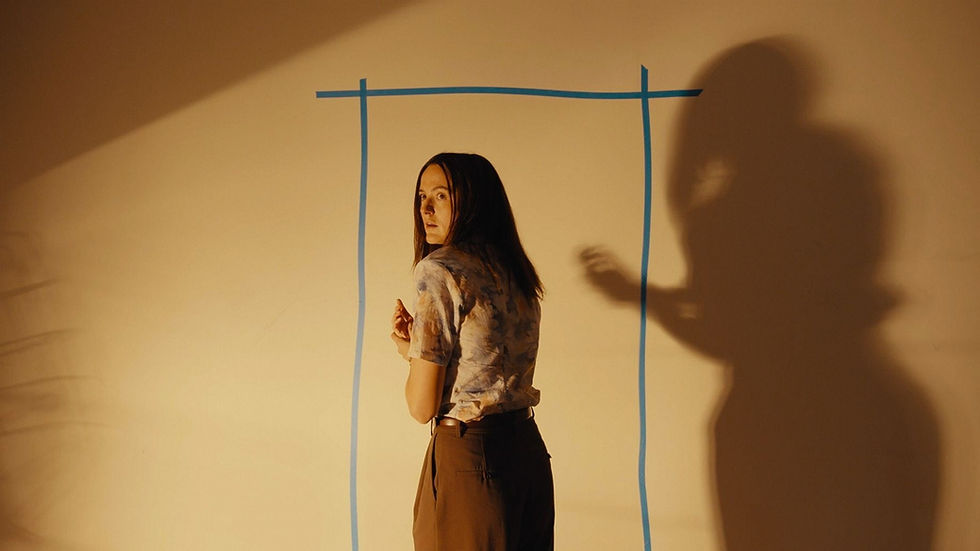
The film also provides a decidedly psychological gloss on the Backrooms - a feature that my 18-yr old daughter didn’t find particular convincing. The two main protagonists - failed architect Clark (Chiwetel Ejifor) and his therapist Mary (Renate Reinsve) play out their professional relationship in the Backrooms themselves, after Clark becomes stuck there. The monsters that live in the Backrooms turn out to be projections of people who venture into these spaces (in the earlier videos they’re stick-like creatures that aren’t explained). In the film, a horribly misshapen version of Clark pursues Mary after she too becomes trapped in Clark’s strange reconstructed memory-scape. But Mary has generated her own backrooms. In perhaps the film’s most extraordinary sequence, we first see Mary in her childhood home, abandoned after her abusive and unstable mother is institutionalised. The camera then reveals a dozen or so variations of the same room as it duplicates itself as multiple Backrooms. Stacked on different levels, the lowest room resembles a crypt, the doorway now a threatening black hole. As Clark discovers, the Backrooms are all the spaces there have ever been: a potentially infinite labyrinth that spatialise time (a nightmare version of the tesseract featured in Interstellar). But these are also misremembered spaces, as if the mind behind the creation of the Backrooms has somehow malfunctioned.
In psychologising the monsters, Backrooms provides a loose explanatory framework for the existence of these endless spaces. They reflect the labyrinthine quality of the human psyche, how the past in the mind doesn’t sit in neat layers like geological strata, but is all mixed up and mostly misremembered.

In a strange coincidence, Backrooms was released just as I was finishing the novel House of Leaves, published in 2000 and written by Mark Z. Danielewski. Like Backrooms, this novel features a vast and potentially infinite series of spaces that appear in a house occupied by photographer Will Navidson and his family. It was written and is set in the 1990s and, like Backrooms, it’s a meta-fiction, featuring three interlinked narratives. These are a fictional film titled The Navidson Record, a text about the film compiled by a figure called Zampanò, and another text written by Johnny Truant describing his own engagement with Zampanò’s. Written before the advent of the Internet, House of Leaves nevertheless posits the same kind of multimedia intertextuality that the Backrooms have generated, as well as a psychological reading of the relationship between fictional and real spaces.
Both House of Leaves and Backrooms say something about how psychic or ‘inner’ space is entwined with real material spaces, and how the nature of our spatial experience is informed by a constant interaction between the real and virtual. The difference between the 1990s and now is that today we’re now almost completely subsumed in a virtual world that actively resists these interactions at the level of experience, even as it is irrevocably bound up with material things and real spaces.
Perhaps the visceral quality of Backrooms lies not only in how it conjures up a time when the physical seemed closer at hand, but also in calling us back to something that has persisted, namely the mixing up of the real and the virtual. Although it warns us of the dangers of noclipping - passing through apparently solid objects like walls and floors into the dangerous Backrooms - it also suggests that it’s only in the misremembered spaces of the world where the possibility of new futures lie. We always have to go back to go forward, even if that means getting lost in the Backrooms.


