Buster Keaton: slapstick anarchism
Updated: Aug 8, 2020

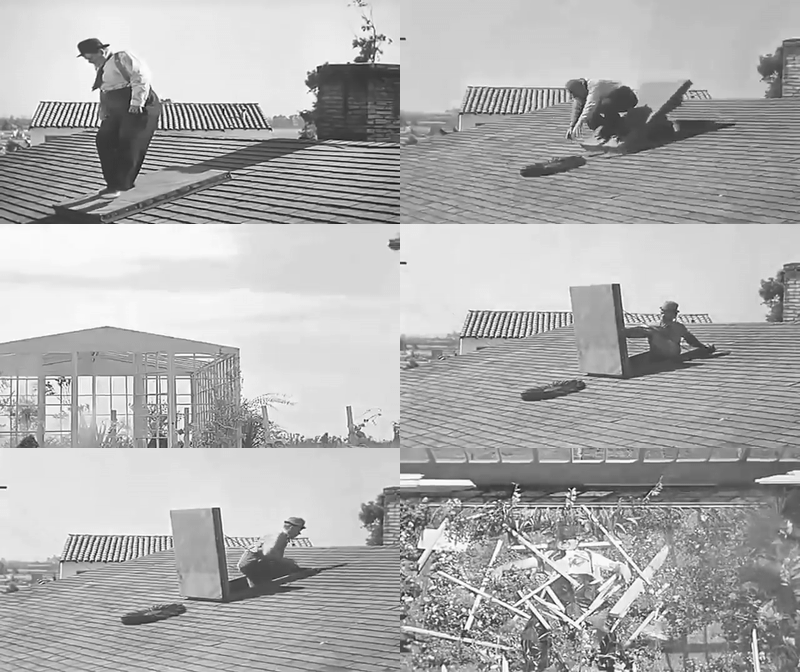
Laurel & Hardy in Dirty Work (1933)

Still from Charlie Chaplin’s Modern Times (1936)
Perhaps more than any other pioneer of slapstick cinema, Buster Keaton delved most obsessively into the workings of architecture and elaborated on its possible absurdist tendencies. Beginning with the short One Week (1920), Keaton explored a whole host of scenarios usually involving the construction of highly-elaborate films sets. Thus, in The Scarecrow, also released in 1920, two men live their entire lives in just one room which is transformed into a multi-purpose space through a variety of gadgets: a bathtub that turns into a sofa; condiments and drinks hanging on strings; and a vertically folding bed that transforms into a piano when raised. A year later, in High Sign, a full-scale cutaway house was constructed to allow four different spaces to be shown at once – spaces in which walls become floors and doors become windows. Thoroughly anarchic in their subverting of modernist ideals of rationality through mechanisation and mass production, Keaton’s early films give voice to a desire to take back control of processes that were, before industrialisation took hold, mostly human-centred and self-organised.

String-pulling in The Scarecrow (1920)

Cutaway house in High Sign (1921)
One Week also draws on Keaton’s own life experiences, particular in his early childhood. Charting the attempt of a newly-married couple to build their own house from a pre-fabricated flatpack, the many mishaps that befall Keaton in this short film recall the uncanny number of accidents that he suffered early on in his family home. In just one day of his life, aged three, he lost part of his finger in a mangle and was also sucked out of his bedroom window by a tornado – remarkably, he was deposited unharmed by the twister a few dozen yards away from his house. The latter event is mirrored in One Week when the finished house is turned into a ‘merry-go-round’ by a violent storm, swivelling alarmingly on its flimsy foundations. The house itself is wrongly assembled by the couple, a result of the numbers on the boxes of flatpack timber being changed by the rejected suitor of the female protagonist. With its sloping verandahs, rhomboid windows and a roof turned ninety degrees on itself, the finished house anticipates the deconstructionist aesthetic that would come to be prized by architects such as Frank Gehry and Daniel Libeskind in the 1990s. Eventually destroyed by a passing train, the house is left at the end of the film as a pile of fragments, the unfortunate couple leaving it behind ‘for sale’ together with the original instructions for assembly.

Assembling the flat-pack house in One Week

House as ‘merry-go-round’ in One Week
One Week satirised the proliferation of prefabricated housing in the USA in the first half of the twentieth century, when companies like Sears & Roebuck advertised self-assembly homes in their catalogues, and which could even be sent to owners by post (as seems the case in One Week). Between 1908 and 1940, approximately 75,000 prefabricated houses were self-built in the US, often on the edges of burgeoning frontier cities like Los Angeles. The popularity of these flat-pack houses flags up the desire on the part of users not only to save money (up to 40% on labour costs), but also for the flexibility of modular systems that allowed them to adapt the homes to their own tastes and needs. But in One Week the promised empowerment of self-building is foiled by first malice, then accident, then nature, and finally, the motive powers of industry itself (the destroying train).

Family home advertised in a Sears & Roebuck catalogue from 1920

A passing train narrowly avoids the house in One Week, before another one coming the other way destroys it
The Parisian Surrealists of the 1920s were fascinated by Keaton’s films – a publicity still from One Week appearing in the very first issue of La Révolution Surréaliste in 1924 along with a text by Louis Aragon. The Surrealists saw a serious intent in Keaton’s absurdism: namely to transform the dry rationalism of industrial technology and efficiency into something magical and wondrous, where unconscious desires came come to the surface. And, beneath the slapstick comedy of One Week, Keaton’s transformation of the house into an anarchic structure where the domestic may at any moment and without warning turn dangerous, is obviously a mirror of his own childhood traumas. Thus, even as the house becomes liberated from its formal constraints and users empowered by its surreal reimagining, it nevertheless also produces darker undercurrents of powerlessness in the face of gigantic forces beyond any individual’s control. The balance between freedom and control in architecture is clearly one that is not easily achieved, beset as it is by the contradiction of fear and desire. Yet, the anarchic house is one in which those contradictions are openly manifest, rather than hidden behind cosy familiarities and the sterile comfort of reductive rationality.
Special thanks to Will Jennings for his wonderful article published in LapsusLima earlier this year on Buster Keaton and architecture, from which several of the gif’s used here were sourced.


